

The flexible packaging industry is changing rapidly as brands, governments, and consumers demand more sustainable packaging solutions. Traditional PET/PE laminate structures have dominated food and consumer packaging for decades because of their excellent strength, printability, and barrier performance. However, the increasing focus on recyclability has pushed manufacturers toward mono-material packaging, with MDO-PE (Machine Direction Oriented Polyethylene) emerging as one of the most promising alternatives.
But can MDO-PE truly replace PET/PE? How do these two packaging structures compare in terms of performance, cost, and sustainability?
This article explores the key differences between MDO-PE vs PET/PE, helping packaging professionals, converters, brand owners, and quality engineers choose the right material for their applications.
What is MDO-PE?
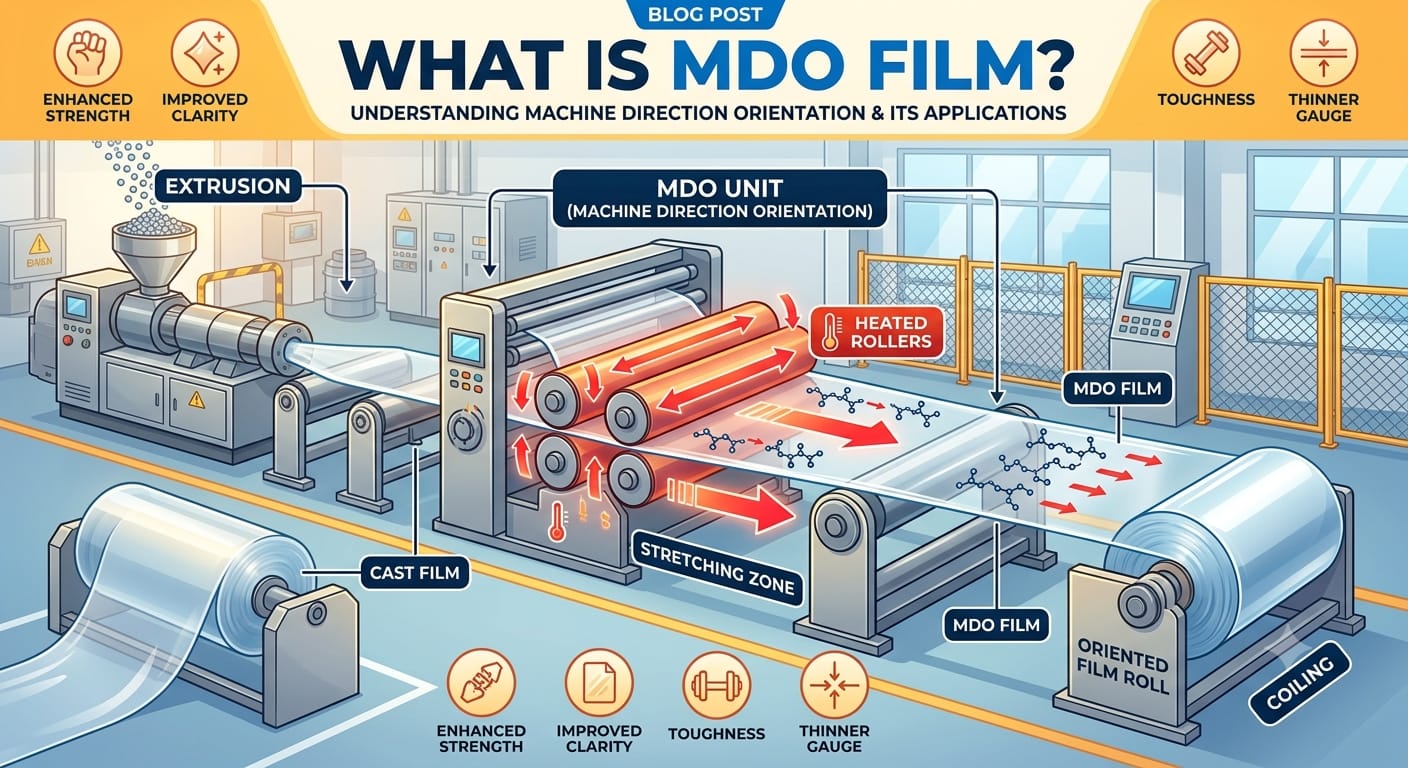
MDO-PE stands for Machine Direction Oriented Polyethylene. It is produced by stretching polyethylene film in the machine direction under controlled temperature and tension. This orientation significantly improves the film's mechanical properties.
Compared to conventional PE film, MDO-PE offers:
- Higher stiffness
- Better tensile strength
- Improved optical clarity
- Enhanced printability
- Lower film thickness without sacrificing strength
Most importantly, MDO-PE enables the production of recyclable mono-material PE packaging, making it an attractive solution for sustainable flexible packaging.
What is PET/PE Laminate?
PET/PE is a multi-material laminate consisting of a polyester (PET) outer layer and a polyethylene (PE) sealing layer.
Each material contributes unique properties:
- PET provides excellent strength, stiffness, heat resistance, and high-quality printing.
- PE offers heat sealability, flexibility, and moisture resistance.
Because both materials are permanently laminated together, separating them after use is extremely difficult, limiting recyclability in most regions.
MDO-PE vs PET/PE: Quick Comparison
| Feature | MDO-PE | PET/PE |
| Structure | Mono-material | Multi-material |
| Recyclability | Excellent | Limited |
| Mechanical Strength | Very Good | Excellent |
| Stiffness | High | Very High |
| Printability | Very Good | Excellent |
| Barrier Performance | Moderate | Better |
| Heat Resistance | Moderate | High |
| Sustainability | Excellent | Moderate |
| Circular Economy Compatibility | High | Low |
Performance Comparison
- Mechanical Strength
PET has long been known for its exceptional mechanical strength. It offers excellent dimensional stability, making it ideal for demanding packaging applications.
However, MDO technology dramatically improves the performance of polyethylene by increasing:
- Tensile strength
- Stiffness
- Machine direction strength
Although MDO-PE does not fully match PET in every application, it performs remarkably well for many food and consumer packaging formats.
Winner: PET/PE for maximum strength.
- Print Quality
PET films provide excellent surface smoothness, resulting in outstanding print quality for high-end packaging.
Modern MDO-PE films are specially designed for:
- Flexographic printing
- Rotogravure printing
- Digital printing
With proper surface treatment, MDO-PE delivers impressive print quality that satisfies most commercial packaging requirements.
Winner: PET/PE (slightly).
- Heat Seal Performance
One of polyethylene's biggest advantages is its outstanding sealing capability.
MDO-PE structures often provide:
- Strong seals
- Wide sealing window
- Reliable package integrity
PET requires an additional PE sealing layer, making the laminate more complex.
Winner: MDO-PE.
- Barrier Properties
Barrier performance depends on product requirements.
PET naturally offers:
- Better oxygen barrier
- Better aroma retention
- Higher temperature resistance
MDO-PE generally requires additional barrier technologies, such as:
- EVOH
- SiOx coating
- AlOx coating
- High-barrier PE formulations
For highly sensitive foods, PET/PE still maintains an advantage.
Winner: PET/PE.
- Processing Efficiency
MDO-PE runs efficiently on many modern:
- Lamination machines
- Printing presses
- Pouch-making machines
However, converters may need process optimization during the transition from PET structures.
As equipment technology continues to improve, MDO-PE processing becomes easier and more reliable.
Winner: Nearly equal.
Cost Comparison
Raw Material Cost
Traditional PET/PE structures have benefited from decades of optimized production and global availability.
MDO-PE may initially appear more expensive because:
- Specialized orientation equipment increases manufacturing costs.
- Production volumes are still growing.
- Some grades require premium resin formulations.
However, several factors help offset these costs.
Downgauging Opportunities
One of the biggest advantages of MDO-PE is downgauging.
Because oriented PE has improved strength, converters can often reduce film thickness while maintaining performance.
This results in:
- Lower material consumption
- Reduced package weight
- Lower transportation costs
- Improved production efficiency
Over time, these savings can compensate for higher material prices.
Total Cost of Ownership
When evaluating overall costs, businesses should consider:
- Material usage
- Waste reduction
- Recycling compatibility
- Transportation savings
- Future regulatory compliance
In many cases, MDO-PE becomes competitive despite a slightly higher initial cost.
Total Cost of Ownership
When evaluating overall costs, businesses should consider:
- Material usage
- Waste reduction
- Recycling compatibility
- Transportation savings
- Future regulatory compliance
In many cases, MDO-PE becomes competitive despite a slightly higher initial cost.
Sustainability Comparison
Sustainability is where MDO-PE truly stands out.
Recyclability
Traditional PET/PE laminates combine two different polymer families.
Separating these materials after use is technically difficult and economically challenging.
As a result, most PET/PE flexible packaging ends up:
- In landfills
- In waste-to-energy systems
- Incinerated
In contrast, MDO-PE structures are typically designed as mono-material polyethylene packaging, making them far more compatible with existing PE recycling streams where such infrastructure exists.
Winner: MDO-PE.
Circular Economy
Many global brands have committed to making packaging:
- Recyclable
- Reusable
- Compostable (where appropriate)
Mono-material PE packaging supports these goals by simplifying recycling and reducing material complexity.
This aligns well with circular economy principles.
Carbon Footprint
Using thinner films through downgauging offers several environmental benefits:
- Less raw material consumption
- Lower transportation emissions
- Reduced packaging waste
- Improved resource efficiency
Although the exact carbon footprint depends on manufacturing processes and logistics, MDO-PE often contributes to lower overall environmental impact when used effectively.
Applications of MDO-PE
MDO-PE is becoming increasingly popular in:
- Snack packaging
- Frozen food packaging
- Stand-up pouches
- Pet food packaging
- Personal care products
- Household cleaning products
- Recyclable shopping bags
- E-commerce packaging
Its versatility makes it suitable for many applications that traditionally relied on PET/PE laminates.
When Should You Choose PET/PE?
PET/PE remains the preferred option when applications require:
- Very high oxygen barrier
- Excellent heat resistance
- Superior stiffness
- Retort packaging
- Premium visual appearance
- Heavy-duty industrial packaging
Despite sustainability concerns, PET/PE continues to deliver exceptional performance for demanding applications.
When Should You Choose MDO-PE?
MDO-PE is an excellent choice if your priority is:
- Recyclable packaging
- Mono-material structures
- Downgauging
- Sustainability goals
- Lower packaging weight
- Compliance with evolving environmental regulations
- Supporting circular economy initiatives
As recycling infrastructure expands worldwide, MDO-PE is expected to play an even larger role in flexible packaging.
Future Outlook
The future of flexible packaging is shifting toward materials that balance performance with sustainability. While PET/PE remains a proven solution for high-barrier and high-performance applications, increasing environmental regulations and brand commitments are accelerating the adoption of recyclable mono-material structures.
Advances in barrier coatings, resin technology, and converting processes continue to improve the capabilities of MDO-PE. As these innovations mature, the performance gap between MDO-PE and traditional laminates is likely to narrow, making recyclable polyethylene packaging a practical choice for an even wider range of products.
Conclusion
The comparison between MDO-PE vs PET/PE is no longer just about mechanical performance—it is also about the future of packaging. PET/PE offers outstanding strength, print quality, and barrier performance, making it a reliable choice for many demanding applications. Meanwhile, MDO-PE delivers significant sustainability advantages through its mono-material design, recyclability, and downgauging potential.
Ultimately, the best choice depends on your product requirements, performance expectations, budget, and sustainability goals. For brands looking to reduce environmental impact without sacrificing functionality, MDO-PE is rapidly becoming one of the most promising innovations in modern flexible packaging.