
Retort pouch structure explained: compare PET/AL/PA/RCPP with modern recyclable mono-PP structures, including barrier, sealing, performance and sustainability.
A retort pouch is usually made from several carefully selected layers. Each layer performs a specific job, from printing and mechanical strength to oxygen barrier, puncture resistance and heat sealing.
Traditionally, structures such as PET/AL/PA/RCPP have been widely used. However, the packaging industry is now moving toward recyclable mono-material retort structures, particularly mono-PP solutions.
So, which structure is better?
The answer depends on the required barrier, retort conditions, product, shelf life, machinery and recyclability requirements.
What Is a Retort Pouch?
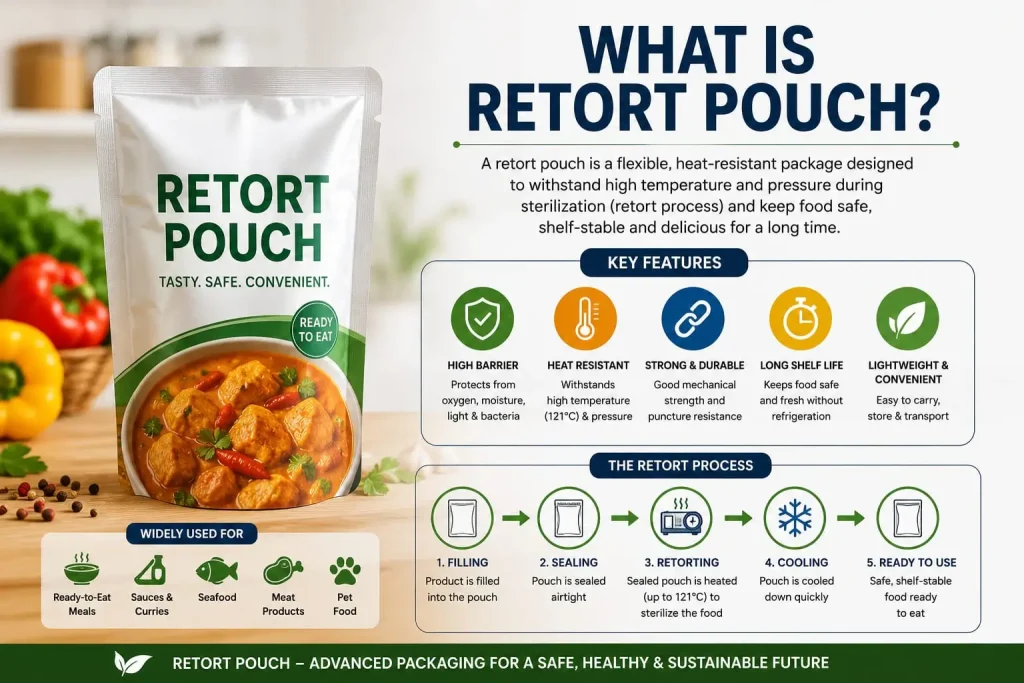
A retort pouch is a flexible package designed to withstand thermal sterilization after filling and sealing. During retort processing, the sealed pouch is exposed to elevated temperature and pressure to make the food commercially shelf-stable.
Unlike conventional pouches, retort packaging must maintain:
- Seal integrity
- Lamination strength
- Dimensional stability
- Puncture resistance
- Oxygen and moisture barrier
- Food-contact safety
- Performance during and after thermal processing
This is why material selection is critical.
A pouch that performs perfectly at room temperature may fail during retort because of heat, pressure, moisture and mechanical stresses.
Traditional Retort Pouch Structure: PET/AL/PA/RCPP
One of the classic high-performance retort structures is PET/AL/PA/RCPP.
It is a multilayer laminate in which each material contributes a different property.
1. PET – Outer Printing and Strength Layer
PET, or polyethylene terephthalate, is commonly used as the outer layer.
Its major functions include:
- Excellent printability
- Good stiffness
- Dimensional stability
- Mechanical strength
- Resistance to handling and transportation
PET provides a good surface for high-quality reverse printing and helps the pouch maintain its shape.
However, PET is a different polymer family from polypropylene. When it is laminated with PP and other materials, the resulting multi-material structure becomes more challenging to recycle.
2. Aluminum Foil – High Barrier Layer
Aluminum foil is one of the most effective barrier materials used in flexible packaging.
It provides extremely strong protection against:
- Oxygen
- Moisture
- Light
- Aroma migration
This makes aluminum foil particularly valuable for products requiring long shelf life and strong protection from environmental conditions.
The disadvantage is that an aluminum-containing laminate is difficult to recycle through conventional plastic recycling systems because the pouch contains multiple incompatible materials.
3. PA – Puncture and Mechanical Resistance
PA, commonly called nylon, is used to improve the mechanical performance of the pouch.
Retort pouch structure products can contain bones, sharp food particles or other components that may stress the package. PA can provide valuable puncture and abrasion resistance.
It also contributes to the overall toughness of the laminate.
However, PA introduces another polymer into an already complex structure, which further increases the material diversity of the laminate.
4. RCPP – Retortable Sealant Layer
RCPP means retort-grade cast polypropylene.
This is the inner layer that comes into direct contact with the product and performs the critical sealing function.
RCPP is specifically designed to maintain seal integrity under demanding thermal processing conditions.
The sealant layer must withstand:
- High temperature
- Pressure
- Food contamination
- Chemical interaction with the product
- Mechanical stresses during retort
A weak seal can result in leakage, swelling, microbial contamination or complete product failure.
Why Is the Traditional Structure So Effective?
The biggest advantage of a multilayer retort pouch is that different materials can be optimized for different functions.
PET provides printability and stiffness.
Aluminum provides outstanding barrier protection.
PA provides toughness and puncture resistance.
RCPP provides heat sealing and retort resistance.
In other words, the structure is engineered as a team rather than relying on one material to perform every function.
That is why conventional retort laminates remain technically attractive for demanding applications.
However, their major weakness is recyclability.
The Shift Toward Recyclable Retort Pouches
Sustainability requirements are pushing flexible packaging manufacturers to rethink traditional multilayer structures.
Recent developments are focusing heavily on mono-material packaging, particularly mono-PP structures. Research published in 2026 also highlights the environmental benefits that can result from moving from multi-material multilayer packaging toward mono-material multilayer designs, although the actual environmental outcome depends on the complete packaging and recycling system.
The objective is simple:
Use one main polymer family while still achieving the performance required from a retort pouch.
For retort applications, polypropylene is particularly interesting because PP-based materials can offer good heat resistance and sealing performance.
What Is a Mono-PP Retort Pouch?
A mono-PP retort pouch is designed primarily around polypropylene-based materials.
A modern structure may use combinations such as:
BOPP / high-barrier PP / RCPP
The exact construction can vary depending on the manufacturer and required barrier performance.
Some high-barrier PP technologies use transparent barrier coatings or specialized barrier films to replace traditional aluminum foil. Recent industry developments include mono-PP high-barrier films specifically targeted at retort applications.
This is important because simply removing aluminum from a retort pouch is not enough.
The replacement barrier must still protect the product throughout its intended shelf life.
Traditional vs. Recyclable Retort Structures
The major difference can be summarized as follows:
| Property | PET/AL/PA/RCPP | Modern Mono-PP Structure |
| Main material approach | Multi-material | Predominantly PP |
| Oxygen barrier | Excellent | Depends on barrier technology |
| Light barrier | Excellent with foil | Depends on structure |
| Puncture resistance | Very good | Structure-dependent |
| Retort performance | Well established | Rapidly developing |
| Recyclability potential | Challenging | Better potential |
| Transparency | Usually opaque | Can be transparent |
| Material complexity | High | Lower |
| Sustainability focus | Limited | Strong |
However, recyclable does not automatically mean environmentally superior in every situation.
Collection infrastructure, sorting, recycling availability, package design and actual recycling rates all matter.
Therefore, packaging developers should evaluate the complete life cycle rather than looking at only one material property.
Can Mono-PP Replace PET/AL/PA/RCPP?
In some applications, yes.
But it is not a simple one-for-one material replacement.
A successful mono-PP retort pouch requires careful engineering of:
- Barrier performance
- Retort resistance
- Seal strength
- Puncture resistance
- Film orientation
- Coating compatibility
- Printing system
- Lamination
- Forming performance
- Filling-line performance
Modern developments demonstrate that mono-PP structures can be engineered for high-barrier retort applications. For example, recent industry solutions use high-barrier PP layers to replace conventional aluminum-containing constructions.
The key challenge is maintaining the same product protection while simplifying the material structure.
Why Barrier Performance Matters
Barrier properties are critical for shelf-stable food.
If oxygen enters the pouch too quickly, it can contribute to oxidation, flavor deterioration and quality loss.
Similarly, moisture transmission can affect the product’s texture, stability and shelf life.
Traditional aluminum foil provides an exceptionally strong barrier, which is why foil-based retort pouches have been so successful.
Modern recyclable structures therefore need advanced barrier technology to approach the required performance without depending on conventional aluminum foil.
High-barrier PP, EVOH-based approaches and transparent SiOx or AlOx technologies are among the technologies being explored for recyclable flexible packaging. However, the suitability of any barrier technology depends on the application and the relevant recycling design requirements.
Retort Pouch Seal Integrity Is Critical
Regardless of whether the pouch uses aluminum foil or a recyclable mono-material structure, the seal remains one of the most important parts of the package.
During retort, the seal experiences heat, pressure and moisture.
A poor seal can cause:
- Leakage
- Channel formation
- Seal opening
- Microbial contamination
- Product rejection
- Reduced shelf life
Therefore, quality control should include seal strength testing, visual inspection, leakage testing and post-retort evaluation.
The pouch should not only survive the retort cycle; it should continue to provide reliable protection afterward.
The Future of Retort pouch Packaging
The future of retort packaging is moving toward a difficult but important balance:
High performance + long shelf life + food safety + recyclability.
Traditional PET/AL/PA/RCPP retort pouch structures remain highly capable, particularly where extremely high barrier performance and proven retort reliability are required.
At the same time, recyclable mono-PP structures are developing rapidly.
Recent 2026 industry developments show that mono-PP high-barrier retort packaging is moving beyond laboratory concepts toward commercial packaging solutions.
The next generation of retort pouches will therefore not simply be about replacing aluminum or PET.
It will be about redesigning the entire packaging structure around performance and end-of-life requirements.
Conclusion
The traditional PET/AL/PA/RCPP retort pouch remains one of the most effective structures for demanding high-temperature food packaging. Each layer has a clear technical purpose, and together they provide excellent barrier, strength and sealing performance.
However, its multi-material construction creates recycling challenges.
Modern mono-PP retort pouch structure offer a promising alternative. By keeping the structure within a polypropylene material family and incorporating advanced barrier technologies, manufacturers are working toward retort packaging that combines high performance with improved recyclability potential.