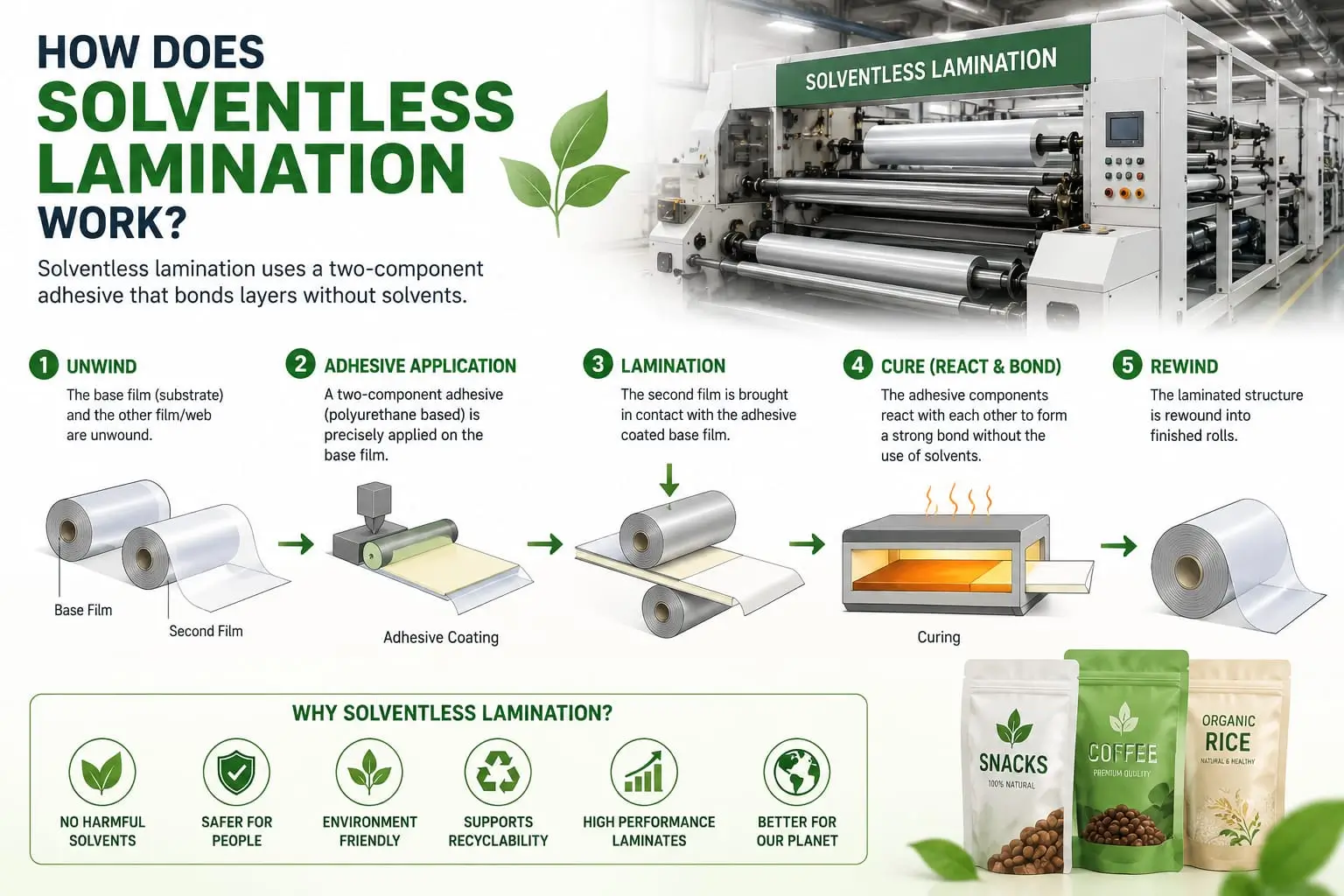
The flexible packaging industry is changing quickly & solventless lamination is more demanding. Brands want packaging that is lightweight, attractive, functional, and increasingly recyclable. At the same time, converters are under pressure to reduce energy consumption, emissions, production waste, and operating costs.
This is where solventless lamination is becoming increasingly important.
Unlike conventional solvent-based lamination, solventless lamination uses adhesives with essentially 100% solids and does not require the large drying-oven stage used to remove carrier solvents. This can reduce VOC emissions and energy demand while simplifying the converting process. Recent research also shows that process optimization is improving the consistency and adhesion performance of solvent-free laminates.
But is solventless lamination simply a greener alternative, or is it becoming a key technology for the future of flexible packaging? Let's take a closer look.
What Is Solventless Lamination?
Solventless lamination is a process used to bond two or more flexible substrates using a solvent-free adhesive.
Typical substrates can include:
- PET film
- BOPP film
- PE film
- CPP film
- PA (nylon)
- Aluminum foil
- Metallized films
- Paper
In a conventional solvent-based lamination process, the adhesive contains a solvent carrier. After coating, the laminated web passes through a drying oven to remove that solvent.
Solventless lamination works differently. A two-component reactive adhesive is accurately metered onto the substrate and the second web is brought into contact with it through the nip section. The adhesive subsequently cures through a chemical reaction.
Because there is no solvent that needs to be evaporated, the process can eliminate the conventional solvent-drying stage.
How Does Solventless Lamination Work?
How Does Solventless Lamination Work?
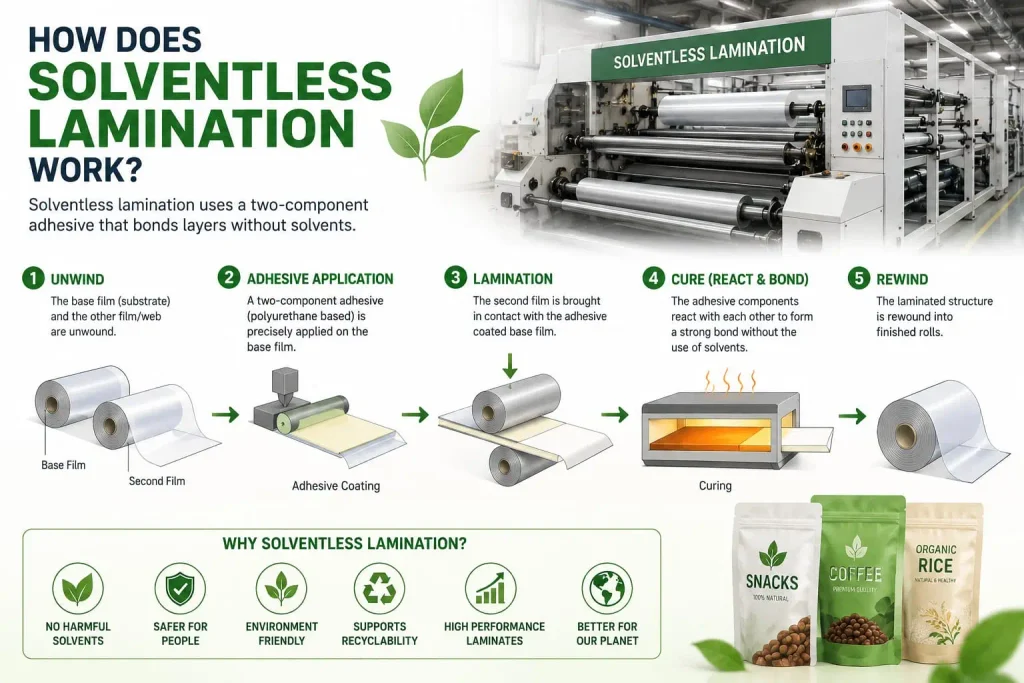
1. Unwinding
Two substrate rolls are mounted on the laminator. One is normally the adhesive-carrying web, while the second substrate is brought into contact during the lamination process.
2. Adhesive Mixing
Many solventless adhesives are two-component polyurethane systems consisting of a resin and a hardener.
The components must be mixed at the correct ratio. Accurate metering is critical because an incorrect mix ratio can affect curing, adhesion, flexibility, and final laminate performance.
3. Adhesive Application
The mixed adhesive is applied as a very thin coating.
Because solventless adhesives contain no solvent carrier that needs to evaporate, precise coating-weight control is particularly important.
4. Lamination and Nipping
The coated web and second substrate pass through the nip rollers. Pressure allows the adhesive to spread and form an effective bond between the layers.
5. Curing
The laminated roll is generally allowed to cure for a specified period before further processing.
The curing time depends on adhesive chemistry, temperature, coating weight, substrates, and application requirements.
Modern solventless systems are also being developed for demanding applications such as retort and hot-fill packaging.
Why Is Solventless Lamination More Sustainable?
The biggest advantage is that sustainability is achieved through the manufacturing process itself, rather than only through the final packaging material.
Lower VOC Emissions
Solvent-based adhesives use organic solvents that must be removed during drying. This creates VOC-management requirements.
Solventless systems eliminate the solvent carrier, substantially reducing this source of VOC emissions. Research comparing lamination processes has reported significant reductions in VOC emissions for solventless systems.
This can help converters move toward cleaner production environments and support environmental compliance objectives.
Lower Energy Consumption
A solvent-based laminator normally needs heated ovens to evaporate solvents.
Solventless lamination does not require the same solvent-drying operation. As a result, energy consumption can be significantly reduced.
One comparative LCA study found that solventless lamination used considerably less electrical energy and produced lower carbon emissions than the dry lamination process examined in the study.
The exact savings, however, depend on the machine, adhesive, production speed, substrate structure, curing conditions, and factory energy source.
Reduced Carbon Footprint
Lower energy consumption and reduced solvent handling can contribute to a lower manufacturing carbon footprint.
This is particularly important as packaging companies increasingly measure emissions across their manufacturing operations.
Modern solventless technology is therefore not simply about replacing one adhesive with another. It can change the energy and emissions profile of the entire lamination process.
Solventless Lamination and Recyclable Packaging
An important point is often misunderstood: solventless lamination does not automatically make a package recyclable.
Recyclability depends on the complete packaging structure.
For example, changing a solvent-based adhesive to a solventless adhesive does not necessarily make a PET/PE or PET/AL/PE laminate recyclable in a particular recycling stream.
However, solventless adhesives can support the development of recyclable structures when they are designed and tested for compatibility with the target recycling process.
This becomes particularly relevant for mono-material packaging, such as PE-based or PP-based structures.
Some adhesive technologies have already received recyclability-related recognition for use with PE film structures, demonstrating the growing connection between adhesive design and packaging circularity.
Solventless Lamination for Mono-Material Packaging
The move toward mono-material flexible packaging is one of the biggest reasons solventless lamination is gaining attention.
Traditional high-performance packaging often combines different materials to achieve strength, barrier properties, printability, and sealability.
However, different materials can make recycling more difficult.
Mono-PE and mono-PP structures attempt to keep the primary polymer family consistent while still achieving the required packaging performance.
Solventless adhesives can play an important supporting role by bonding these layers without introducing a large solvent-based adhesive system.
This is why the future of sustainable flexible packaging is likely to involve film design + adhesive technology + printing + recycling compatibility, rather than focusing on only one component.
Is Solventless Lamination Suitable for High-Performance Packaging?
Yes, but the adhesive and process must be selected correctly.
Flexible packaging can demand resistance to:
- Heat
- Moisture
- Oils and fats
- Chemicals
- Puncture
- Flex cracking
- Retort processing
- Hot filling
Modern solventless adhesive technologies are expanding into demanding applications. For example, new solventless systems have been developed specifically for retort packaging, targeting performance comparable with solvent-based alternatives while avoiding solvent drying.
This is important because sustainable packaging cannot succeed if it sacrifices product protection.
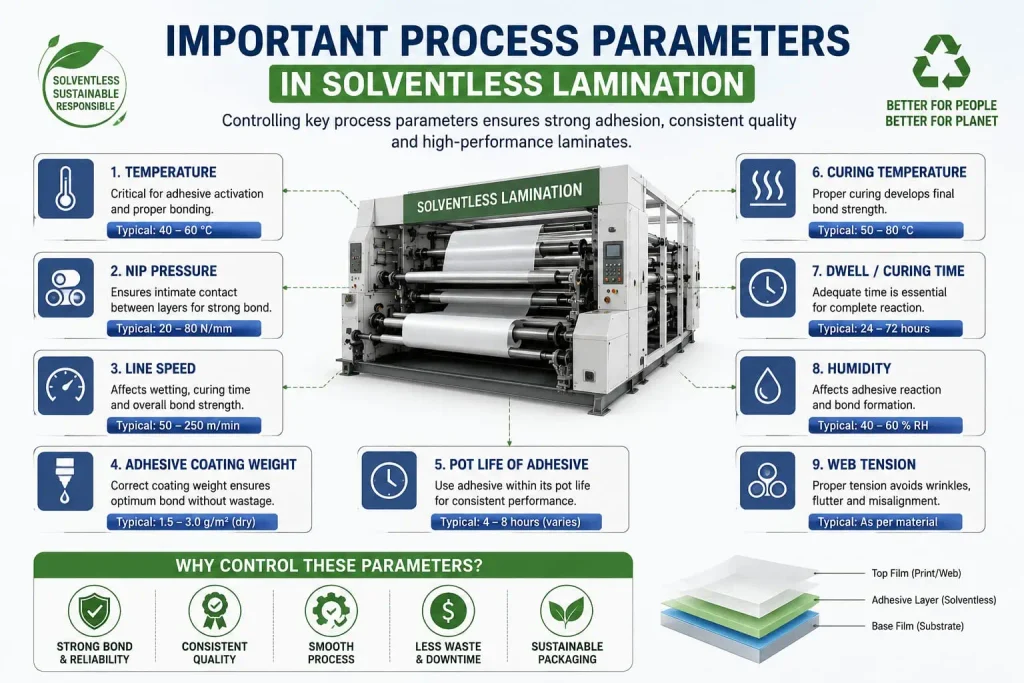
Important Process Parameters in Solventless Lamination
Surface Energy
Poor substrate wetting can lead to weak adhesion, tunneling, delamination, or other laminate defects.
A 2026 study found surface energy to be the most influential parameter among the factors investigated for adhesion strength in a solvent-free lamination system.
Adhesive Mix Ratio
The resin-to-hardener ratio must remain within the adhesive manufacturer's specified range.
Incorrect ratios can result in incomplete curing or undesirable laminate properties.
Coating Weight
Too little adhesive may produce inadequate bonding, while excessive adhesive can increase cost and potentially affect appearance, curing, or performance.
Machine Speed
Increasing line speed can change adhesive application, wetting, mixing, and nip conditions. Therefore, speed must be balanced with the adhesive's working characteristics.
Temperature
Application temperature influences adhesive viscosity and coating behavior. Temperature control is therefore essential for consistent coating and bonding.
Solventless vs. Solvent-Based Lamination
| Factor | Solventless Lamination | Solvent-Based Lamination |
| Solvent use | No carrier solvent | Uses solvent |
| VOC generation | Very low from adhesive process | Higher |
| Drying oven | Generally not required | Required |
| Energy demand | Generally lower | Generally higher |
| Process complexity | Lower in some areas | More equipment-intensive |
| Curing | Reactive curing | Drying + curing |
| Sustainability potential | High | Lower |
| High-performance applications | Increasing rapidly | Well established |
Solvent-based lamination remains an important technology for many applications. Solventless lamination should therefore be viewed as an expanding alternative rather than a universal replacement.
Challenges of Solventless Lamination
The technology also has limitations.
Achieving consistent adhesion can be more demanding because there is no solvent carrier helping to control viscosity and wetting.
Operators need strong control over:
- Adhesive temperature
- Mix ratio
- Coating weight
- Surface treatment
- Web tension
- Nip pressure
- Machine speed
- Curing conditions
Recent research confirms that several interacting process parameters can influence adhesion performance, making process optimization important for industrial production.
What Is the Future of Solventless Lamination?
Packaging converters are looking for ways to reduce VOC emissions and energy consumption while maintaining productivity and laminate performance.
At the same time, recyclable and mono-material packaging structures are creating new technical requirements for adhesives.
Machine manufacturers and adhesive suppliers are responding with faster-curing systems, improved wetting, better adhesion, and solventless solutions for demanding structures.
Recent industry developments are even targeting solventless retort lamination and high-speed multilayer production, showing that the technology is moving beyond simple applications.
Final Thoughts
Solventless lamination is becoming more important in sustainable packaging because it addresses several challenges at the same time.
It can reduce solvent-related emissions, lower energy requirements, simplify the converting process, improve workplace conditions, and support the development of recyclable packaging structures.
However, sustainability should not be judged by the adhesive alone. The complete packaging system—including substrates, inks, coatings, adhesive, manufacturing process, product protection, and end-of-life recycling—must be considered.
For flexible packaging converters, solventless lamination is therefore more than an environmental trend. It is becoming an important process technology for the next generation of efficient, high-performance, and more sustainable flexible packaging.
4. Can solventless lamination be used for retort pouches?
5. What is the main advantage of solventless lamination?
6. What are the most important solventless lamination parameters?