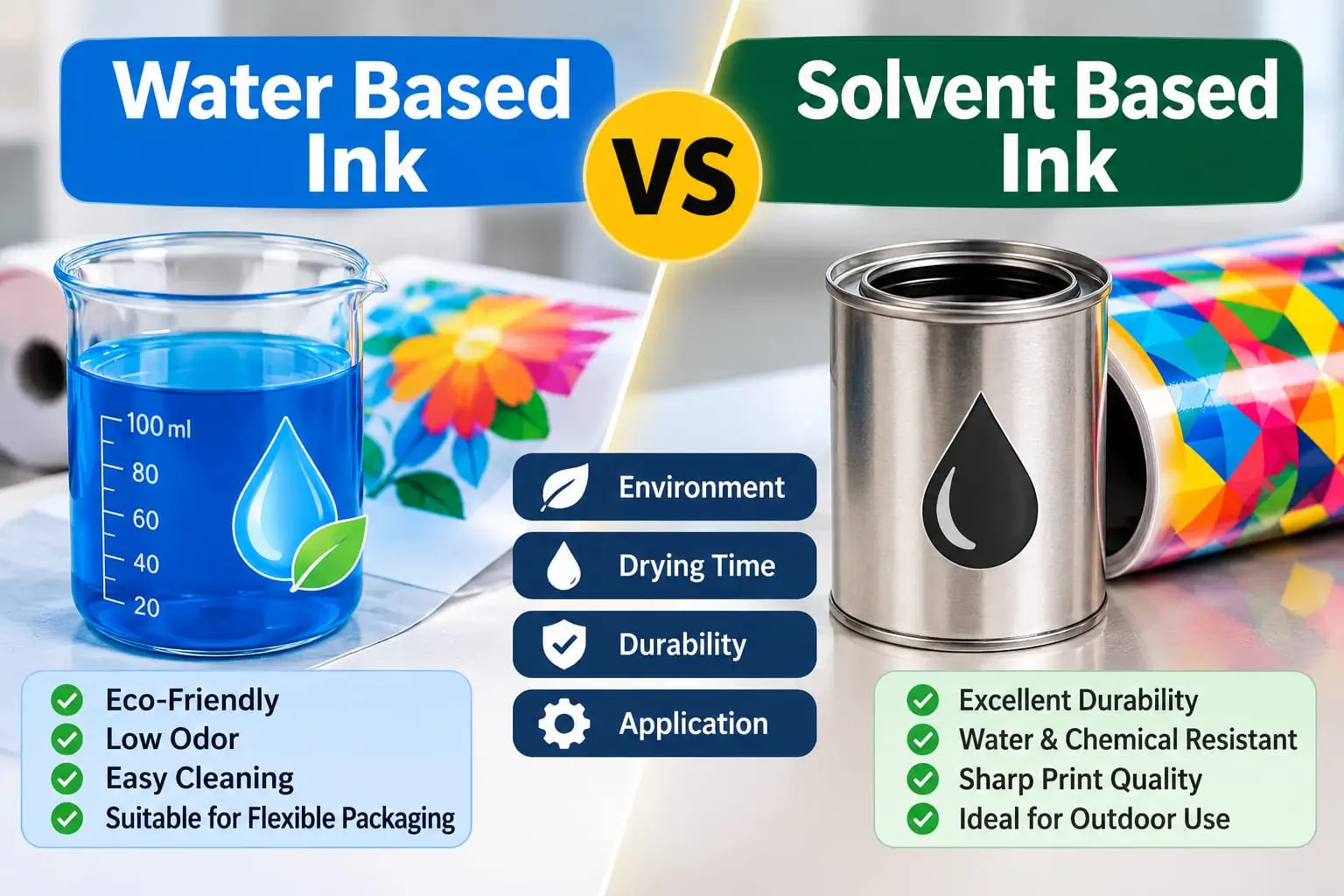
Water-Based Ink vs Solvent-Based Ink plays an important role in the flexible packaging industry. It not only gives packaging an attractive appearance but also helps communicate product information, branding and essential details to consumers.
In flexible packaging, two commonly used ink technologies are water-based ink and solvent-based ink. Both are used in printing applications, but they differ in composition, drying mechanism, printing performance and environmental impact.
With increasing demand for sustainable packaging and lower VOC emissions, water-based ink is receiving greater attention. However, solvent-based ink remains an established technology in many flexible packaging applications because of its printing performance and compatibility with different plastic films.
In this article, we will understand the differences between water-based ink and solvent-based ink, their advantages, disadvantages and applications in flexible packaging.
1. What Is Water-Based Ink?
Water-based ink is a printing ink in which water acts as the primary liquid carrier. It contains pigments, resins, additives and other ingredients required to achieve the desired printing properties.
During printing, the ink is transferred onto the substrate. After application, water evaporates through a controlled drying system, allowing the ink film to form on the surface.
Water-based inks are commonly used in flexographic printing, particularly for paper, corrugated materials and selected plastic film applications.
Main Components of Water-Based Ink
- Pigments: Provide colour and opacity.
- Resins: Help the ink adhere to the substrate and form a stable film.
- Water: Acts as the main liquid carrier.
- Additives: Improve properties such as wetting, defoaming, flow and printability.
- Co-solvents: May be added in controlled quantities to improve drying and film formation.
The exact composition depends on the printing process, substrate and ink manufacturer's formulation.
2. What Is Solvent-Based Ink?
Solvent-based ink uses organic solvents as its primary liquid carrier. These solvents dissolve or disperse the resin system and help maintain the required viscosity during printing.
After the ink is transferred onto the substrate, the solvents evaporate through the drying system, leaving a solid ink film containing pigments, resins and other components.
Solvent-based inks are widely established in flexible packaging, especially in gravure and flexographic printing.
Main Components of Solvent-Based Ink
- Pigments: Provide colour and opacity.
- Resins: Provide adhesion, flexibility and film-forming properties.
- Solvents: Control viscosity and help dissolve or disperse the resin system.
- Additives: Improve printability, flow, slip and other performance characteristics.
Common solvents used in suitable printing ink formulations include ethyl acetate, ethanol and isopropyl alcohol (IPA).
The selection of solvent depends on the resin system and required printing performance.
3. Difference Between Water-Based Ink and Solvent-Based Ink
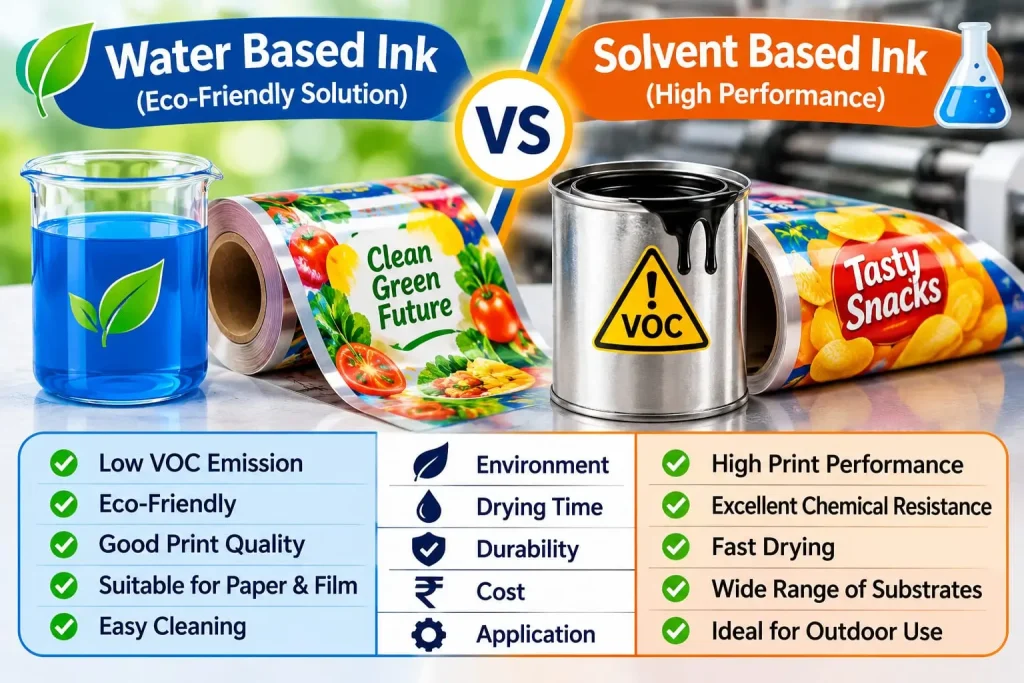
Both technologies are designed to deliver good printing quality, but their properties are different.
Parameters| Water-Based Ink| Solvent-Based Ink
Main carrier| Water| Organic solvents
Drying mechanism| Water evaporation| Solvent evaporation
VOC emissions| Generally lower| Generally higher
Odour| Generally lower| Formulation-dependent
Fire risk| Generally lower| Higher due to flammable solvents
Drying requirements| May require more energy| Depends on solvent blend
Plastic film adhesion| Requires suitable formulation| Established formulations available
Environmental considerations| Water and wastewater management| VOC and solvent management
Common applications| Paper and selected plastic films| PET, BOPP, PE and other films
Important: Actual performance depends on ink formulation, substrate treatment, printing speed, drying capacity and operating conditions. Neither technology is automatically suitable for every flexible packaging structure.
4. Advantages and Disadvantages of Water-Based Ink
Advantages
1. Lower VOC Emissions
Water-based ink generally produces lower VOC emissions compared with conventional solvent-based systems. This makes it an attractive option for printers looking to reduce organic solvent consumption.
2. Reduced Flammability Risk
Because water is the primary carrier, water-based inks generally have a lower fire risk than solvent-based inks. However, proper chemical handling and safety procedures are still necessary.
3. Environmental Benefits
Water-based ink can support environmental improvement initiatives by reducing the use of organic solvents.
Disadvantages
1. Drying Challenges
Water evaporates differently from organic solvents. Therefore, sufficient drying capacity and controlled air circulation are important, particularly at higher printing speeds.
2. Plastic Film Adhesion
Achieving good adhesion on non-absorbent materials such as BOPP, PET and PE can be challenging without suitable ink formulation and surface treatment.
3. Humidity Sensitivity
High humidity and temperature variations can affect water evaporation and printing performance.
5. Advantages and Disadvantages of Solvent-Based Ink
Advantages
1. Established Printing Technology
Solvent-based inks have a long history in flexible packaging and are widely used in gravure and flexographic printing.
2. Good Film Compatibility
Suitable solvent-based formulations are available for substrates such as BOPP, PET and PE, depending on the printing application.
3. Drying Performance
Appropriately selected solvent blends can provide fast drying and support high-speed printing operations.
4. Printing Quality
Solvent-based inks can provide good colour strength, print definition and adhesion when the formulation and printing conditions are properly controlled.
Disadvantages
1. VOC Emissions
Evaporation of organic solvents can release VOCs into the atmosphere. Proper exhaust and emission-control systems are important.
2. Fire and Explosion Risk
Many organic solvents are flammable. Therefore, adequate ventilation, electrical safety, fire protection and solvent-handling procedures are essential.
3. Solvent Retention
If the printing process is not properly controlled, residual solvents may remain in printed material. This is particularly important in food packaging applications.
6. Applications in Flexible Packaging
The selection of printing ink depends on the substrate, printing method and final packaging requirements.
Water-Based Ink Applications
Water-based inks are commonly used for:
- Paper packaging and paper bags.
- Corrugated packaging.
- Selected PE film applications.
- Certain flexible packaging structures using specially developed formulations.
Solvent-Based Ink Applications
Solvent-based inks are widely used for:
- BOPP printed packaging films.
- PET reverse printing.
- PE film printing.
- Snack food and confectionery packaging.
- Laminated flexible packaging structures.
- Gravure and flexographic printing applications.
For reverse printing, the ink is printed on the inner side of a transparent film and protected by the subsequent laminated layer.
7. Important QC Tests for Water-Based Ink vs Solvent-Based Ink
Quality control is essential for both water-based and solvent-based printing inks. Poor ink performance can lead to printing defects, customer complaints and lamination problems.
The following tests are particularly important:
1. Viscosity Test
Viscosity determines the flow behaviour of ink during printing. It should be checked using an appropriate viscosity cup or instrument according to the ink manufacturer's recommended method.
2. Ink Adhesion Test
Adhesion testing helps determine whether the ink is properly bonded to the substrate.
A suitable tape test can be used to evaluate ink adhesion, following the agreed testing procedure.
3. Drying Test
The drying performance should be checked to ensure that the printed ink has dried sufficiently before winding or the next converting operation.
4. Rub Resistance Test
This test evaluates the resistance of the printed surface to rubbing and handling.
5. Residual Solvent Test
Residual solvent testing is particularly important for solvent-based inks used in food packaging. It helps verify that solvent levels meet the applicable customer and regulatory requirements.
6. Lamination Bond Strength
For laminated structures, bond strength testing helps evaluate the compatibility and performance of the printed layer with the adhesive and substrate.
8. Which Ink Is Better for Flexible Packaging?
There is no single answer because both ink technologies have different strengths.
Water-based ink can be a suitable choice when reducing VOC emissions and organic solvent consumption is a major objective. However, successful implementation requires suitable ink chemistry, surface treatment and sufficient drying capacity.
Solvent-based ink remains a practical choice for many flexible packaging applications because of its established printing performance and availability of formulations for different plastic films.
Before selecting an ink, manufacturers should consider:
- Type of substrate: PET, BOPP, PE or paper.
- Printing process: Flexographic or gravure.
- Required printing speed.
- Drying capacity of the machine.
- Ink adhesion and lamination compatibility.
- Food packaging requirements.
- Environmental and safety requirements.
Conclusion
Water-based ink and solvent-based ink both have important roles in the flexible packaging industry.
Water-based ink offers opportunities to reduce VOC emissions and organic solvent consumption, while solvent-based ink continues to provide established solutions for a wide range of plastic film printing applications.
The right ink selection depends on technical requirements, production conditions, substrate compatibility and end-use applications.
For flexible packaging manufacturers, the goal should not simply be to select the ink with the lowest cost or lowest VOC emissions. Instead, the focus should be on achieving consistent print quality, good adhesion, reliable lamination performance and compliance with applicable packaging safety requirements.
As printing technology develops, water-based ink formulations may become increasingly relevant for more flexible packaging applications.
---
1. What is the main difference between water-based ink and solvent-based ink?
The main difference is the liquid carrier. Water-based ink primarily uses water, whereas solvent-based ink uses organic solvents.
2. Is water-based ink suitable for BOPP film?
Yes, specially formulated water-based inks can be used on BOPP films. However, surface treatment, adhesion and drying performance must be evaluated.
3. Why is solvent-based ink widely used in flexible packaging?
It offers established printing solutions, suitable adhesion formulations and good drying performance for many plastic film applications.
4. Which ink is more environmentally friendly?
Water-based ink generally has lower VOC emissions. However, its complete environmental impact also depends on manufacturing, energy consumption, additives and wastewater management.
5. Can water-based ink replace solvent-based ink?
It can replace solvent-based ink in selected applications, but it is not a universal replacement. The substrate, machine capability, drying system and final packaging requirements must be considered.